The Snickersnee Press
Devoted to Rediscovering Ben Hecht Biography & Works
431 Fifth Street NE
Washington, DC 20002
fax: 202 547 0132
snickers
Ben Hecht Holiday Thoughts
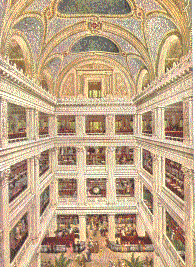
As a seasonal offering, we invite you to enjoy Ben Hecht's "Holiday Thoughts." Like other Jewish-American reporters, Hecht was expected to find the words to put readers into the holiday spirit, that is, the spirit of the dominant holiday of Christmas. In carefully chosen words, Hecht writes about the need to "observe" Christmas, which he sets forth into the city to do with the faithful eye of a reporter.
Toys in a Chicago department store animate and weary workers nod off on the " L" trains in an essay that captures the contradictions and poignancy of the season. He concludes that: Christmas gives us all the same gift: The gift of memory.
Florice Whyte Kovan
Left, Marshall Field's Chicago Department Store under the Tiffany Dome circa 1910.Right, below, Mandel Brothers Department store at State and Madison in Hecht's boyhood. Library of Congress General Collections images.
Scroll down
Holiday THOUGHTS, by Ben Hecht
Traditions are things which take the place of initiative. And so people lean on them. Traditions make it seemingly necessary to do things that they would not ordinarily do, because they were too tired, too empty or too lacking in interest. The observing of the great holidays is a matter of tradition. There are many noble-hearted people who might experience a dawn of love for the fellow man toward the end of the year if there had never been a Christmas. But they are in the minority.
The loop is a bit more congested than usual. I have been very busy elsewhere.
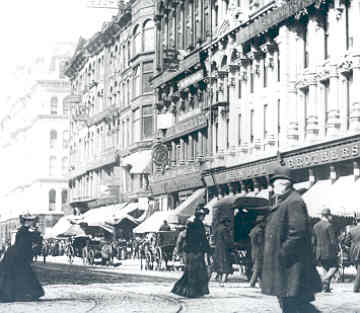
Thus, walking or pushing my way down State street, I wonder what great general is visiting the city today, and where the parade was. Then I remember that it is the holiday season and these are shoppers. Then the stores must be crowded one more. Holly wreaths are hanging from the columns. Cotton batting is doing service for snow decorations. tinsel and glittering aticles gleam from shelves.Allons--- We will investigate.
A hullabaloo. The heavy shuffle and a dim roar. The crowd sucks you in like a vacuum. Counters of smart gloves, perfumes, laces, jewelry, waists, stockings. They drift by. People like the business of buying gifts. Aside from the bartering aspects of the thing --- of hoping to get presents as nice as the ones they sent --- there is the glow of altrusim. People like to good to others. It gives them a feeling of strength, and emotional intimacy. Also, to buy something that appeals to you and to send it to a friend is like winning an argument hands down. In so doing you impose your own tastes graciously upon him.
The shuffle of the huge store crowd is so determined, it seems as though it has direction and plan. As if everyone were going somewhere instead of drifting aimlessly like myself up and down aimless aisles.
The elevator is jammed. It takes fifteen minutes to get one. The toy department! Here's a piquant chance to expand sentimentally. A vaguely familiar air of glamour rests on the scene.
Vaguely familiar noises, music, shouts. Vaguely familiar counters. I pause and stare at a crockinole table. I can remember, yes. And across the aisle, toy trains. They wind up. And one that runs by electricity. Hm! Indian suits and drums. Wooden clowns. Great cardboard games in which you spin a needle and advance markers according to ---- according to something.The toy department is like an almost familiar memory. It brings a faint sadness. One says repeatedly to oneself: "I remember. Yes, of course, I remember this. And that."
It seems suddenly preposterous that one was ever a child. Impossible. One says without words: "It couldn't have been me. Someone else. Not me."
And then the things on the counter begin to gesture hauntingly. The name of games wink intimately from gaudy cardboard boxes. The electric train whirs teasingly round and round the white tin track.Noises blur. The scene becomes a blur also. And one drifts along staring with amused eyes at a toy clown, at a toy Noah's ark. There is a poignancy in the moment, the poignancy of revisiting old scenes after a long absence. The old scene contains magically a part of one;s youth. Yesterdays are embalmed in them.
And here each toy is like and old scene. Each toy seems crowded with yesterdays.
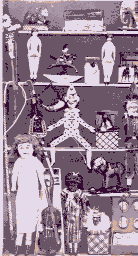
I look around. A crowd of people. Chiefly people older than myself. And a minority of children. Middle-aged, tired-faced people handling toys. Staring with almost idiotic enthusiasm at dolls and drums and mechanical contrivances that dance or jiggle or crawl.The eyes of these people tell a haunting story. "Look, we have grown old. We once played with toys. Now we are old and tired." And their fingers stray caressingly on pieces of tin and cardboard.
Then there is a psychology of toys. Of course. Children like them. They take the place of ideas and institutions in the minds of children.
But men and women use them more determinedly. Men and women play with them during the furtive moments of purchase and the half-sad, half-elate
consciousness of having once been children and of having once reveled in such things.Somehow this connects my thought with the notion of tradition. Around Christmas, tradition addresses people in a preemptory voice. This is
because the tradition in this case is based upon innumerable other traditions and has been canonized and made powerful by long and enthusiastic worship. The preemptory voice of the
Christmas tradition makes it socially and well as spiritually necessary to "observe Christmas." Pity the sad iconoclast maintaining an absurd rationality in the face of the colorful sentimentalism of the holidays. An outcast. Worse.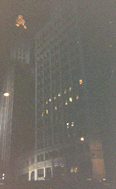
The memory of the toy department comes with me into the street. Middle aged tired faces. Riding home in the crowded street car I look at faces. I notice that people seldom hold their necks stiff, that they permit their heads to loll to a side and that their features droop. They sit in an open-eyed conscious sleep. Their attitudes remind one of people who have been pummeled
and manhandled and tossed into the discard.Along the evening residential streets the homecomers appear to become a little more alive. I pass the grocery store, butcher shop, drug store, corset shop. These are store fronts familiar on the way to home. Usually their lighted interiors animate me and make me think of labyrinths.
Now, these interiors and the dark streets that seem interiors also appear for the moment simplified. They are for tired people, worn people. Very sad people whose single great fortune is that they were once children. Now they go around with absurdly long faces and devoting themselves to the absurd business of earning money and spending it again. And once a year these tired aging ones come to the confessional of the toy department, and with poignant grimacings, coo and gurgle once more over dolls and drums.
We once lived in a world of toys. In a world of adventure. In a world of strange
thoughts and weird imaginings. Adventure, thoughts and imaginings were toys like these. Yes, these toys have souls because we remember that they meant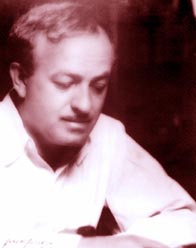
something, were something.What is it they meant and were?
But we've forgotten that. Almost. And the crowd of men and women shuffle up and down the aisles and down the streets outside. The holidays bring them all an identical gift. The holidays bring them the gift of memory.
*******
The top three photographs above are from the collections of The Library of Congress. the foggy Wrigley Building photo was taken by Flori Kovan. Ben Hecht photo portrait, right, The Newberry Library, Chicago.
Holiday Thoughts was published in the Ben Hecht Story & News Holiday 2000 Issue and the subsequent Ben Hecht Story & News Compiled.
431 Fifth Street NE
Washington, DC 20002
fax: 202 547 0132
snickers