A web site devoted to Ben Hecht Biography & Works
431 Fifth Street NE
Washington, DC 20002
fax: 202 547 0132
snickers
Ben Hecht in New York
-"Wandering on Broadway and in the Loop after work . . . their hearts beat faster at the vision of their monuments. Their eyes feel a sensation of ocular pride and tenderness."
------Ben Hecht, "In Behalf of Art," in ART & ARCHITECTURE ON 1001 AFTERNOONS. Snickersnee 2002
.
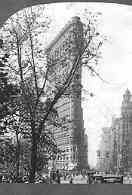
Ben Hecht must have felt right at home when he beat a bitter retreat from his beloved Chicago to his native New York. Here he could savor Chicago architect Daniel Burnham's 1902 Flatiron Building, now celebrating over 100 years at 23rd and Broadway. Hecht became fascinated by Chicago's skyscrapers, when they were the highest ones and followed the trend to New York in the soaring Twenties. In the 1940s the RCA Building and the Empire State Building were among the New York subjects of his stories.
Libary of Congress Photograph
Hecht was born in New York on February 28, 1894 to immigrant Jewish parents from southern Russia. After a childhood on the lower East Side of New York and Chicago, middle school and high school in Racine, Wisconsin and salad days as a journalist in Chicago 1910-1925, he returned to New York with his mistress Rose Caylor, who became his second and enduring wife. They lived for a time in an apartment on the Lower East Side, then at Beekman Place before buying a house on the Hudson in Nyack (seen right) a residential location also chosen by Hecht's collaborators Charles MacArthur
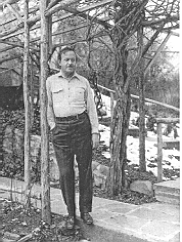 and Kurt Weill. Ben & Rose later moved to an apartment in Central Park West near the Tavern on the Green. Ben Hecht died there on April 19, 1964.
 Hecht's early film writing for New York Paramount reminds us that the American movie industry started in New York and worked its way west to Hollywood. His 1930s collaborations with Charles MacArthur, among them Design for Living, Crime without Passion and Soak the Rich, were produced by the raucus pair at Paramount's Astoria Studios in Queens. While his cinematic techniques originated in silent film artistry and respect for
extraordinary camera work (he partnered with Lee Garmes), it was the stage that inspired him; thus he thought of himself always as a scenarist or playwright. Hecht's Broadway plays varied in commercial success, his Front Page hit with MacArthur dominating the legacy of his Broadway career. Three of his plays of the World War II era championed causes of interventionism (Fun to Be Free) and rescue of Holocaust victims (We Will Never Die). Marlon Brando fans will find an early siting in Hecht's post-World War II play about the new nation of Israel, A Flag Is Born, in which they worked with the prominent Adler theater family.In 1940 Hecht conspired with George Grosz to create an illustrated anthology "1001 Afternoons in New York," a selection of pieces published originally in PM, Manhattan's anti-isolationist tabloid. Hecht's pioneering live television talk show of the 1950s, "The Ben Hecht Show," was produced in New York by a young Mike Wallace.
Ben Hecht's Holocaust Play, We Will Never Die
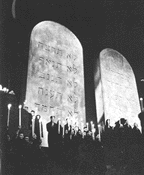
April 1943 was an intense month for Ben Hecht as he toured his star-studded pageant We Will Never Die, about the slaughter of Jews in Europe, as it was happening. Curiously, few Americans knew at the time about what became known as the Holocaust; therefor Hecht met with the hostility directed to the bearer of bad news. The prominent rabbi Stephen Wise did not feel Hecht was a qualified messenger and discredited his efforts, so the production had to scramble for funds at every venue. Hecht, along with producer Billy Rose, personally picked up the tab for deficits. The pageant's initial staging was directed by Moss Hart at Madison Square Garden. It went on to play in Washington DC, Philadelphia, Boston, Chicago and Hollywood with changes in the cast, updates and local variations.
The pantheon of renowned actors working in We Will Never Die included Paul Muni, Joan Leslie, Akim Tamiroff, Ralph Bellamy, Katrina Paxinou, John Garfield, Burgess Meredith, Paul Henreid, Claude Rains, and Edward G Robinson. Kurt Weill wrote the musical score. With the uprising of the Warsaw Ghetto in mid-April, Hecht recreated that heroic struggle in a new scene, engaging Franz Waxman to compose stirring music. Above is a scene from the Madison Square Garden production.While Ben Hecht is often thought to have come into an awareness of Jewish life and issues mid-career in the 1930s, his early childhood in the New York Jewish ghetto impressed him with the storytelling of immigrant aunts and uncles, whose kitchen table topics and cadences he recalled in his memoir, A Child of the Century. In young adulthood his scenarios of plays based on Jewish ghetto life in Chicago were written for that city's pioneering little theater of the 1910s.
********************
On commutes to New York from home in Oceanside, California, Hecht sometimes
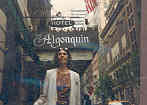
stayed at the Algonquin, a haunt since his Round Table days of the 1920s. Seen under the Algonquin marquee to the left is Florice Whyte Kovan, Ben Hecht scholar, the author of this web site and the editor of the Hecht anthologies of the Snickersnee Press. While these anthologies have dealt primarily with Hecht's Chicago work of the early 1920s, information about Hecht as a writer about New York and a New York writer threads through through our Ben Hecht Story and News and this web site.
431 Fifth Street NE
Washington, DC 20002
fax: 202 547 0132
snickers