A web site devoted to Ben Hecht Biography & Works
431 Fifth Street NE
Washington, DC 20002
fax: 202 547 0132
snickers
Ben Hecht 101 Hard-To-Find Stories, Pg 2
101 Hard-to-find Ben Hecht Stories from The Chicago Daily News and The Chicago Literary Times, with Research & Notes by Florice Whyte Kovan
Copyright Florice Whyte Kovan. All Rights Reserved. Quote or link with this citation: Ben Hecht: 101 Hard-to-Find Stories, Florice Whyte Kovan, Snickersneepress.com/
Continued from first page. Source is Chicago Daily News, unless noted otherwise. 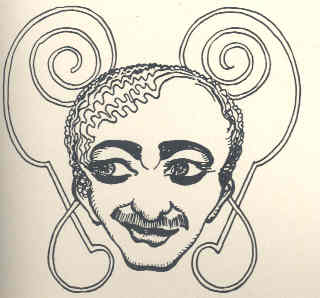
Right, Ben Hecht caricature by Herman Rosse
The New Market.
The stock value of Hollywood movie character types is detailed in the latest losses and gains in the currency of market trends. May 23, 1922. In Print!
The New Skyscraper.
Hecht watches the construction of the Temple Building, which is to be topped by a spired Methodist church, and ponders how people imbue skyscapers with meaning. May 15, 1923, Chicago Literary Times.
Nicholas Roerich.
The renowned Russian artist is in Chicago before his Himalayan expeditions. In this interview by Hecht he speaks of how to bring art to the masses. December 20, 1921. In Print
Notes by a Bogus Classicist.
Hecht and his friend and illustrator Wallace Smith argue about the superiority of ancient sculptures over attempts to recreate them in the then popular neo-classical style. May 1, 1922. In Print!
Papa Seitz.
A bass horn musician plays only one note all of the time, possibly a reference to the director John F. Seitz, whose then-current movie was Four Horsemen of the Apocalypse. November 23, 1921.
Peer Gynt’s Panhandle.
The newspaper man interviews Clarence O’Toole, who claims to be an architect and has a plan for putting all of the buildings in Chicago into four skyscrapers, likely a spoof on Frank Lloyd Wright. October 13, 1922. In Print!
A Perfect Exposure.
A married woman who longs to be in movies takes a job demonstrating products in a store window, much to the chagrin of her husband. October 8, 1921. In Print!
Peshka and the Great Urge.
A housewife who longs to be in movies is scammed by a bogus production company that steals her furniture as they direct her in emoting for the camera. May 12, 1922. In Print
Petrovivacity.
Silent film diva and intellectual Olga Petrova discusses modernist philosophy with artist Herman Rosse. September 19, 1922. In Print! Read full text here,
The Picador.
The Spanish bull-fighter who played the picador in Blood and Sand is outraged that Rudolf Valentino, an Italian, was given the lead role of the matador. August 24, 1922. In Print!
Piquant Tragedies.
People in spectacular high-risk work are felled by ordinary household accidents. February 2, 1922.
A Plot For a Story
An low-key incident in the life of Hecht’s editor friend is suggested as an idea for a film. September 21, 1921. In Print!
Poet’s Bride Bares Soul.
About the life and work of a headline writer at a Chicago newspaper. September 23, 1922.
Practical Joking.
Leo Dietrichstein, actor then starring in Hecht’s play The Egoist, plays a practical joke on his theatrical agent. October 12, 1922.
Reality versus Sham.
Charlie Chaplain and a friend of Ben Hecht both enter a Charlie Chaplin look-alike contest. May 22, 1922. In Print!
Rhyme of the Parlor Cow.
A calf raised in a small house becomes too big to get out. August 5, 1921 .
Sahara
Hecht and a friend attend the exhibition of American art at the Art Institute of Chicago. Dismayed at the quality of the works, they decry the exclusion of most modernists; but they regrouped as refusees to exhibit elsewhere. November 15, 1921. In Print!
Sergeant Kuzick’s Waterloo
A police officer, retiring after a lifetime on the Chicago crime beat, blows his 15 minutes of fame by failing to recall a single incident to relate. He asks the newspaperman to let him think about it and come back tomorrow. March 4, 1922.
A Slight Error
Movers move the wrong household of furniture. May 9, 1922.
South Chicago St. Paul.
A religious zealot believes he is leading tens of thousands of people out of evil Chicago to salvation when they follow him onto the rush hour train. November 3, 1921.
Spring Song___Beware!
A German brass "ump-ah" band that used to play on street corners before World War I, makes its first post-war reappearance gingerly, hoping not to find a hostile audience. March 31, 1922.
Street Images.
Chicago streets --- South Water, Canal, Michigan Avenue, Madison Street, and the area near the Chicago Masonic Temple --- create psychological associations in Hecht’s mind’s eye. October 1, 1923, Chicago Literary Times.
A Study in Still Life.
Dawn at the South Water Street Market inspires vivid descriptions of “cubist” produce and observations about which ethnic groups sell what wares at the market. July 14, 1921. In Print!
The Sullen Faucette.
A couple with a successful cabaret act in which the man devotedly observes his partner splits up when the woman is offered her own solo act. Hecht and a friend compare the psychology of the duo act and the failed solo one. July 14, 1922. In Print.
Tears, Tears, Tears.
How the silent film heroines are made to cry by directors is the subject of a fun story naming Blanche Sweet and Norma Talmadge. February 10, 1922. In Print!
Terezia Mjdrechova.
An optimistic immigrant girl is at the train station en route to a Western town from Europe, wearing a tag telling her name and destination. June 25, 1921.
Toothpick Humoresque.
Portrays the lunch-hour exodus of office workers into the city streets, where they take in the scene. September 8, 1921.
Troubles, Troubles.
Teenage siblings living in crowded conditions try leaving the house to be on their own; but come back, including a daughter in trouble with the Morals Court. The mother is devastated by this. January 13, 1922.
Urbimania.
Hecht celebrates the Chicago cityscape as an art form while taking on the criticism of Anatole France toward the urban scene. June 15, 1922. In Print!
La Vie Boheme Again.
Financial problems typical of artists who live only on selling their paintings are described in the case of Russian painter I. Mortimer Block, who was then displaying at Marshall Fields Department Store. March 27, 1922.
Vive L’Humanite.
A speaker in a park is beaten up for saying that lobbyists influence members of Congress and that his audience might vote to replace them. August 31, 1921.
Vox Populi.
The newspaperman (Hecht) is disturbed by the daily presence of a shell-shocked World War I veteran selling Easter cards at the L station. April 3, 1922.In Print Full text on our site
A Western Tale.
A cowboy recalls his wedding night, a shivaree and a macabre outcome. September 15, 1923. Chicago Literary Times.
Wild Roofs.
Artist Herman Rosse talks about the inspiration his modernist art takes from the factories of Rodgers Park as he sees them from the train into Chicago. August 12, 1921. In Print!
Window Magic.
An attorney becomes infatuated with a woman he sees working in an office across the courtyard. He proposes marriage, not realizing that he is proposing to the summer replacement for the object of his affection from afar. August 6, 1921
Wings of Happiness.
Hecht portrays the pleasures of keeping rooftop pigeons in the city. September 28, 1921.
Wounds in the Rain.
In a street in front of the Newberry Library, a man seriously defaced by an accident in a laboratory shows a handsome picture of his former self to a young woman, whereupon she flees. April 6, 1922.
The Wrong Front.
One incident concerning borrowing money from an associate stigmatizes a man irrevocably in the eyes of the lender. January 1, 1924, Chicago Literary Times.
Copyright Florice Whyte Kovan. All Rights Reserved.
To quote or link use this citation: Ben Hecht: 101 Hard-to-Find Stories. Florice Whyte Kovan, Snickersneepress.com/ plus date.
431 Fifth Street NE
Washington, DC 20002
fax: 202 547 0132
snickers