A web site devoted to Ben Hecht Biography & Works
431 Fifth Street NE
Washington, DC 20002
fax: 202 547 0132
snickers
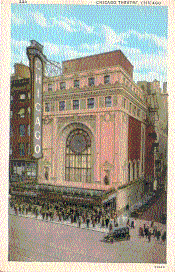
Hecht Wrote His First Movie In Chicago
Sheet music courtesy Library of Congress
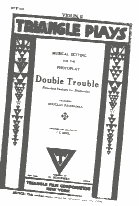 | DOUBLE TROUBLE Double Trouble was one of Ben Hecht's first produced film scenarios, a 1915 silent film, and the earliest one we have documented. That is not to say we might not find an earlier one. Hecht wrote the treatment, initially sending the story line to Anita Loos, a prolific American film writer and a celebrity. Now best remembered for her play, Gentlemen Prefer Blondes, Loos could not forget how Hecht wrote and sent her the treatment.--he hastily scribbled it on a used envelope and gave the missive to actor Douglas Fairbanks to deliver-- a bit impudent, she thought in her memoir. Loos recalled then having to flesh out the farcical and complicated antics in a written continuity in which Fairbanks starred. Hecht was a Chicago journalist at the time, making good money on the side ghosting for Loos and other writers uncredited. Florice Whyte Kovan's research about Hecht's formerly undocumented film interests in Chicago of the 1910s is published in Rediscovering Ben Hecht: Selling the Celluloid Serpent, Snickersnee Press. Her discovery and compilation of Hecht's Chicago Daily News columns about movie-making dates Hecht's film career much earlier than other Hecht biographers. Chicago was in the mid-teens itself a center for film production, technical work, publicity and, we find, writing, even as the bigger New York film industry was moving to Hollywood. Chicago journalism historians will find editor Lloyd Lewis in several silly stories in his early life as a press agent. |
Above is AC Breil's sheet music for Double Trouble, and it's is not for a surging Hollywood sound track, but for the surging live orchestra in the movie theater. This was a silent film and the music was played by local musicians who peeked at the screen and their cue sheets to coordinate music with the emotions-- all in real time. Even in smaller towns, musicians found steady work playing in movie theaters. If all went well, the music written for each film came to the theater in the box containing the film reels. If not, they played from their repertoire of familiar tunes that suggested the mood of each scene.
Additional images from the Double Trouble cue-sheets appear in Selling the Celluloid Serpent, Snickersnee Press's book of Ben Hecht's silent film stories. The textual notes on the sheets describe some of the madcap scenes vividly. Also in the book is a picture of Anita Loos dressed Chinese style, a fashion rage in the early 1920s.
Ben Hecht's Oscars were for writing Underworld 1928, about Chicago gangland and The Scoundrel starring Noel Coward, 1935
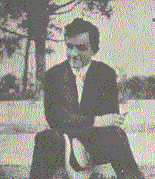 Hecht on his park bench in Chicago's Grant Park |
rld Chicago
Ben Hecht at Chicago Centerstage Ben Hecht Books Ben Hecht's Titanic Verses
Ben Hecht's Chicago Art & Architecture Ben Hecht and Marilyn Monroe
431 Fifth Street NE
Washington, DC 20002
fax: 202 547 0132
snickers