A web site devoted to Ben Hecht Biography & Works
431 Fifth Street NE
Washington, DC 20002
fax: 202 547 0132
snickers
Home
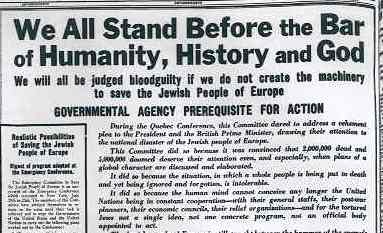
New York Times, Full Page Advertisement, 1943
April 12, 2017
Quoting from my thumbnail biography of Hecht to the right, His greatest effort must be remembered as his awareness of the Holocaust of millions of Jews in World War II Europe when other Americans were ignorant, incredulous, or non-responsive. Hecht's collaboration with Kurt Weill on the 1943 Holocaust-awareness musical pageant We Will Never Die remains his stirring and frustrating journalistic effort to use musical theater to turn world events.
This pageant came to Washington, DC where Eleanor Roosevelt and power brokers of the American government heard Hecht's special plea in which the actors, after the end of the pageant, made their case to take urgent action to save the Jews of Europe.
Bookmark this page for specifics later this week about Hecht's We Will Never Die Washington DC performance.
Florice Whyte Kovan, Hecht biographer/bibliographer, editor of this site.
________________________
Even the most ardent Hecht fans have missed many of these short stories of Chicago, where Hecht's felt his greatest literary inspiration and output. Note Ben Hecht 101 Hard to Find Stories from the Chicago Daily News and the Chicago Literary Times my annotated bibliography of the 1001 Afternoons in Chicago Stories.
Savor the variety in Ben Hecht 's Chicago literay journalism. Here are four columns from his 1001 Afternoons series that I was the first to reprint my anthologies and now offer online.
Vox Populi, about a homeless World War I veteran
Petrovivacity Feminist silent movie diva Olga Petrova
I Got the Blues Chicago blues scene of the 1920s
Hecht at the Opera with Mr. Prokofiev
You may buy our compilations of the lost stories from his 1001 Afternoons in Chicago newspaper series here for immediate shipping.
BEN HECHT IN CHICAGO LITERARY HALL OF FAME
Ben Hecht was inducted in the Chicago Literary Hall of Fame on December 7, 2013. As he is without descendents to receive the award, Hecht's statue was received by David Spadafora, Librarian and President of the Newberry Library, home of the Hecht Collection. I was pleased to have had something to do with this,thanks to the Hall of Fame's request to me for input. Now the award statue will join Hecht's Oscar for Underworld among the artifacts in his collection, under the care of Martha Briggs, Lloyd Lewis Curator of Midwestern Manuscripts. Ben Hecht and his 1001 Afternoons in Chicago series was honored at the Cliff Dwellers club on November 15. Hecht mentioned the cliff dwellers in a title for his Oscar-winning silent film, Underworld, likely referring both to the elite literary organization of which he was not a member and the local term at the time for inhabitants of the skyscrapers of Chicago, where the vertical city was pioneered.
The events co-partnered by Roosevelt Univiersity on Michigan Boulevard aptly provided space in buildings familiar to Hecht not only in his workday as a journalist devising metaphors for the skyline on a park bench across the street, but in his off-hours as a budding playwright in Chicago's pioneering little theater with Kenneth Sawyer Goodman.
The other inductees this year were L. Frank Baum, Edna Ferber, Leon Forrest, John H. Johnson and Thornton Wilder.
Florice Whyte Kovan
Ben Hecht Bio-Bibliographer
Hecht/Kovan: Art & Architecture on 1001 Afternoons in Chicago
April 2014
How gratifying it is to find a new cover story about Ben Hecht, A Stone for His Slingshot, by Ben Hecht with an Introduction by Stuart Schoffman. It reprints a 1948 speech made by Hecht at Slapsie Maxie's in LA, "financed by Mickey Cohen." Here is the link to it in the current Jewish Review. Don't miss the lively cover illustration by Mark Anderson!
And we must correct the text in that Hecht won two Oscars, not one. After he won for Underworld at the very first Oscars event he won again in 1935 for The Soundrel, co-written with Charles MacArthur. The definitive source is The Oscars Database Florice Whyte Kovan
************
We are reading
John Heartfield and the Agitated Image: Photography, Persuasion and the Rise of Avant-Garde Photomontage, a tour de force illustrated biography by Andres Mario Zevigon (University of Chicago Press).
It includes material about Ben Hecht's days with Heartfield, Georg Grosz and the Dadaists in war torn Berlin 1919 when Hecht was a correspondent for The Chicago Daily News.
Buy the book here. It is beautifully written and informative about John Heartfield’s development of photomontage, the art of the film still and the use of art and design as persuasion whether ideological or to buy products.
I am still reading it and as I follow Zervigon's text on the evolution of Berlin Dada I hope to connect the dots from Hecht's experience with the Dadaists to his work when he returned to Chicago.
More later,
Florice Whyte Kovan
See our 2-fer special:
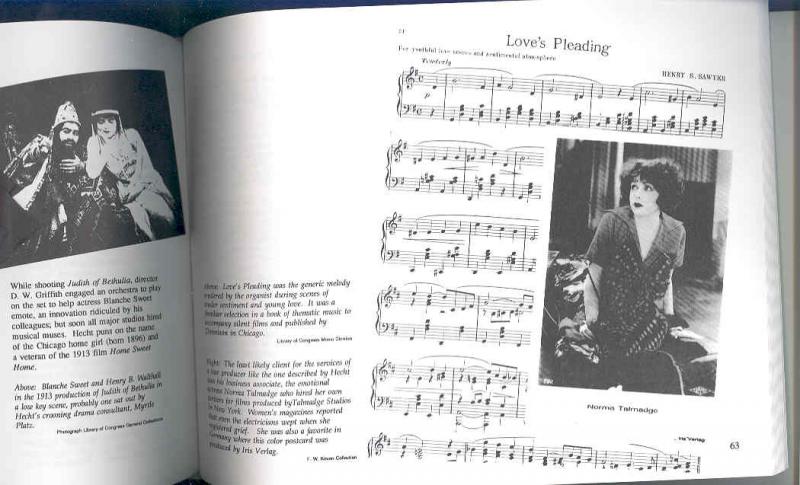
Rediscovering Ben Hecht: Selling the Celluloid Serpent, Florice Whyte Kovan's compilation of Ben Hecht's 1001 Afternoons columns about the silent film actors, directors and movie publicity agents of the early 1920s.
Selected from our Archives
July 15, 2013
Recently visiting Toronto we attended a Toronto Symphony concert featuring a piece by Ben Hecht's collaborator Franz Waxman, an immigrant from Silesia who fled to Toronto and became a distinguished composer for Hollywood films, winning Oscars for Sunset Boulevard and A Place in the Sun. I became acquainted with Waxman's work when working for the Holocaust Museum on picture research to illustrate the libretto of Ben Hecht's pageant We Will Never Dien the stage play Hecht dared to write as events in Europe were occuring and spare information about the death camps systematically killing Jews was buried in the back of the New York Times. Hecht and his initial and primary musical collaborator Kurt Weill launched the pageant at Madison Square in March 1943, beginning a sweep of major American cities intended to produce a groundswell of support for a more aggressive American campaign to save the Jews of Europe. A Washington DC performance added pleas targeted to the attending political VIPs among them Eleanor Roosevelt. Then in April came the news of the uprising of the Warsaw Ghetto, where young Jews who discerned their bleak alternatives put up a heroic fight with weapons reportedly contributed by the desperate Polish Resistance. Hecht knew Waxman's ear for drama since his European and Hollywood film music from Blue Angel to Bride of Frankenstein and Hitchcock films Rebecca and Suspicion. The two of them toiled uncredited (Hecht by preference) on Gone with the Wind and in the same year the composer directed the music for Hecht's prouder achievement Wuthering Heights. Hecht convinced Waxman to score a new scene for We Will Never Die to update the saga with current events. Music and words portraying the savage combat were incorporated seamlessly into the existing pageant one of whose basic concepts was the legacy of the fighting Jew. Following performances in Philadelpha and Chicago, and Boston, the pageant, now expanded was directed by Franz Waxman in its Hollywood Bowl performance. There were only six one or two-day venues but that is another story, well told by musicologist Bret Werb (see link below).
I sat listening at the Toronto concert to Waxman's arrangement of Bizet's Carmen themes written for the violinist character in the movie Humoresque, with the notable violinist palying, My mind however, wandered to his original, stronger stuff, his tour de force Battle of Warsaw music, which haunted me since I heard on a recording narrated at the Hollywood Bowl performance in the throaty, hissing, sometimes blood-curdling voice of Katina Patinou. She won an Oscar that year for For Whom the Bell Tolls. Dripping with spleen she speaks of Hitler's plan for the Tribinka death camp. To end the scene Waxman changed tone in his Battle Hymn of the Ghetto with lyrics by Broadway lyricist Frank Loesser: "Tears no longer, Tears no longer, let them taste the death they deal, and though we die we die in battle not beneath the tyrant's heel."
I just looked up Franz Waxman in Wikipedia because it is so widely consulted initially and purportedly open to additions. No mention of his Battle of Warsaw. Perhaps it is on Waxman's official web site which I find not navigating well as of this writing. Do the people of Toronto, where Franz Waxman is honored as a local talent know about this work as a remarkable stand-alone piece to be preserved and performed? Do the historians of film music or military music of World War II know it exists? For a thorough coverage of how Ben Hecht, Kurt Weill and Franz Waxman collaborated in the face of Holocaust denial or disinterest in the United States, read Bret Werb's We Will Never Die: A Pageant to Save the Jews of Europe http://orelfoundation.org/index.php/journal/journalArticle
Florice Whyte Kovan
** Patinou won an Oscar that year for For Whom the Bell Tolls
May 7, 2013.
Chicago area fans of Ben Hecht and others who can get to Chicago's North Side: Buy your tickets to 1001 Afternoons in Chicago by ACM Access Contemporary Music and the Strawdog Theatre.
Tuesday, May 21 7:00 PM
Architectural Artifacts
4325 N. Ravenswood Ave.
May 4, 2013 AND THE STORIES ARE . . .
The six Ben Hecht stories to be dramatized and set to music at a Chicago performance on May 21 in a collaboration between Access Contemporary Music and the Strawdog Theatre of Chicago are:
Grass Figures, Don Quixote and His Last Windmill, Thumbnail Lotharios, The Mother, Dapper Pete and the Sucker Play, and Clocks and Owl Cars, as revealed by ACM composer Seth Boustead , a Hecht aficionado who spearheaded the joint project.
Here is what I can tell you about the individual stories, which were reprinted by the University of Chicago Press.
Grass Figures
In an exquisitely plainspoken way, Hecht contemplates people lying on the grass in Grant Park on Chicago's downtown lakefront. He does this in the course of mulling the consciousness of writerly inspiration and the process of selfhood as a reflection of the city. Why do people lie on the grass?
Back from a brilliant year covering post- war Germany, Hecht was given carte blanche to write the Chicago scene daily in the Chicago Daily News, that's six days per week. He would people-watch and building-marvel, sometimes in the character of "the reporter," approaching strangers about what they were thinking and doing. The 1001 Afternoons in Chicago series and its individual pieces echoed the European literary tradition of the feuilleton, series of literary observations of the city published in newspapers, as George Fetherling, Hecht's most scholarly biographer, observed in reviewing one of my Hecht anthologies.
As he was about to leave the city permanently, wrenched by divorce, obscenity charges for his illustrated book Fantazius Mallare and the trauma of turning thirty(!), Hecht revisited the Grant Park setting for the last time in My Last Park Bench where he voiced a bittersweet leave-taking of his youth.
Expect Grass Figures to figure prominently in the May 21 drama and original music program as a wellspring for the other stories to be interpreted by the actors and musicians.
And why do people lie in the park and what does it all mean? Hecht: "The huge inverted music notes the telephone poles made against the dark played a long, sad tune in his mind"
Florice Whyte Kovan
Save the date
for the
Access Contemporary Music/ Strawdog Theatre Production
Tuesday, May 21 7:00 PM
Architectural Artifacts
4325 N. Ravenswood Ave.
$20 at the door, $12 online, $8 students and seniors.
Update A live online broadcast of the producction is planned for June or July on WFMT. We will keep you posted.
April 26, 2013
Ben Hecht's tuneful youth as a Chicago reporter and his ear for dialogue on its streets will be finding new voice at a North Side venue, a collaboration of ACM, Access Contemporary Music and the Strawdog Theatre.
I have just heard from Seth Boustead of ACM, Access Contemporary Music in Chicago about a new project honoring Ben Hecht. It's a live radio project featuring theatrical readings of six of Hecht's 1001 Afternoons in Chicago stories, columns from the Chicago Daily News of the 1920s as dramatized by the Strawdog Theatre company and set to original music composed by Boustead and Amos Gillespie.
The performance at Architectural Artifacts on the North Side, will be broadcast on live radio and -- good news! -- will be recorded for posterity to the continuing delight of lovers of Hecht and old Chicago.
This editor promises to hold forth on what she knows about the specific stories chosen for dramatization and how they fit into Hecht's remarkable body of work.. More later!
Save the date:
Tuesday, May 21 7:00 PM
Architectural Artifacts
4325 N. Ravenswood Ave.
$20 at the door, $12 online, $8 students and seniors
Link below.
Hecht's 1001 Afternoons in Chicago Stories Spoken and Set to Music -- live in Chicago!
Chicago reporter Paul Dialing on the project.-- and thanks, Paul, for the kind words!
Florice Whyte Kovan
March 24, 2013
Ben Hecht's Early Plays of the Jewish ghetto
A little known period in Ben Hecht's creativity is the mid 1910s when he was the scenarist of several credited one-act plays of Chicago's Jewish ghetto, plays produced during the city's pioneering little theater movement. Co-authored with Kenneth Sawyer Goodman, namesake of the theater in Chicago, the plays featured characters and plots in which Hecht captured the status and dynamics of early 20th Century Jewish immigrants striving for their livelihoods and aspiring to social mobility.
Among the characters are a mother who groomed her son to be a virtuoso violinist, only to find that he will not stay for her sponge cake when he stops home briefly on his professional tour; a blind patriarch who owns a puppet theater which is eyed by his son-in-law for a movie house; would-be young marrieds in a sweatshop, where one is dying of tuberculosis; a wife who after moving out of the ghetto with her spouse, then expects him to wear a tie and jacket in their apartment.
Depite their Jewish names and places, these playlets were likely received and understood by many middle class theater-goers as generic social issues emanating from the new immigrant mix, with resonance not to Jews only (I say this also because the first paperback I bought for myself was a collection of stories by Harry Golden, who I sometimes thought was describing precisely certain "old neighborhoods" of the immigrant Poles in my extended non-Jewish family).
These plays of the Jewish ghettos in America demonstrate that well before the 1930s, Ben Hecht was interested in the Jewish experience of assimilation and accomodation in America, creating personalities and story lines from family and neighborhood people and situations he knew very well in his childhood and during the lifetime of his immigrant parents.
Florice Whyte Kovan,
October 1, 2012; March 24, 2013
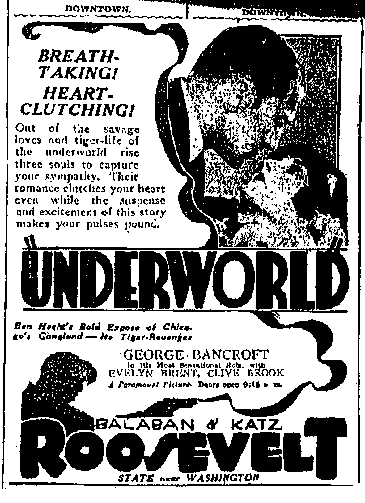 Ben Hecht won the first Oscar awarded to a writer for original story for the silent film Underworld at the first Academy Awards. This Chicago crime story, followed by Scarface established Hecht as the progenitor of the American crime genre in motion pictures. He remained in New York for the first awards ceremony, piqued at how his female character Feathers became mere eye candy instead of the more resourceful woman of his script. She didn't just pose for her big close-up, she devised a plan to get her man out of prison. His second Oscar was for the more lyical The Scoundrel, starring Noel Coward. Image below is from the Chicago Daily News.
Hecht's first Oscar was for Underworld, a story about gangland Chicago.Image from our book Selling the Celluloid Serpent.
Florice Whyte Kovan, writer of this web site
101 Hard-to-Find Stories by Ben Hecht
**************************
 Ben Hecht's first story to cause a front page sensation hit sixteen years before his Broadway hit The Front Page. It was his scornful Titanic disaster poem "Master and Man." written in real time as the ship was sinking, the rhyme has surfaced in recent literature, but lacking (more)
Archived
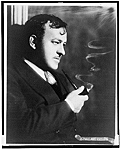
Chicago. The Hecht collection at the Newberry Library is in the news, or rather the Times today, in an article about the future of marginalia in a digital age. We can tell you that any thorough biography of Ben Hecht must include information from the scribblings of his wife Rose Caylor in the margins of his books and letters. See Paul Ghel, curator with some Hecht marginalia in the illustrated New York Times article by Dirik Johnson. Scroll down this column for more about Rose.
A less known aspect of Ben Hecht was his work for human rights and civil rights. Read our page about his work against the Klan and his promotion of African Americans in creative work in Chicago and Hollywood.
*****
When Ben Hecht left Racine, Wisconsin for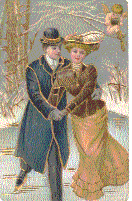 a career as a Chicago journalist in 1910, he was probably dressed something like the dapper fellow to the right, in bowler hat and Chesterfield coat, although not necessarily on skates.
Growing up in Wisconsin, Hecht loved
winter sports; an early biographical dictionary cites ice skating as his favorite. He ended his massive memoir A Child of the Century on a happily wintery note with his little daughter Jenny sledding down a hill in Nyack just as he did in his boyhood in Racine. I know that sled hill because, like Ben, I grew up on that hill overloking Lake Michigan, two generations later. His last line in Child is, "Watching her I remember a lad in Racine. My book is done, but it is beginning all over again."
Hecht's poignant and fanciful story about the holiday rush: Holiday Thoughts.
Now Annotated! 101 Hard-to-Find Stories by Ben Hecht
Hecht at the Prokofiev opera opening
Hecht's 50 Books that Are Books.
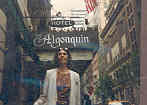
Above, a glimpse of Florice Whyte Kovan, writer/producer of books about Ben Hecht and the editor of this all-Hecht website. In the background is the Algonquin Hotel in New York, where Hecht was an associate of the Round Table literary set. Photo by Allan Kovan, circa 2000.
Ben Hecht Rediscovered: Notes from the editor, Florice Whyte Kovan
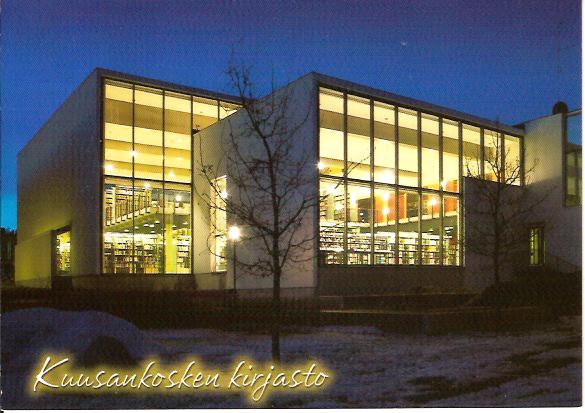
Washington, DC Have you fathomed the remarkable online Authors Calendar, a biographical dictionary of authors written by Petri Liukkonen, former director of the Kuusankosken kirjasto, the library of a dynamic new town in Finland? Liukkonen's English language biographies include notes, bibliographies and quotes capturing the essense of each writer. You may have read many of these pages because they are likely to be high in the search engine rankings, which is where we found an interesting biography of Ben Hecht. The site gets 100 million hits per year with 15 million unique visitors and is designed and managed by Ari Pesonen to provide access to authors alphabetically and by birthday. As we write this on October 29, it is the birthday of detective writer Fredric Brown; October 30 is Ezra Pound; Halloween, October 31, is Keats, and so on. Ben Hecht's birthday is February 28. Photo of the library by Christiane, January 2009.
We hear of Ben Hecht preservation in regard to his script-doctoring of Gone with the Wind. The Theater Guild of Racine, Wisconsin, Hecht's boyhood home, is currently staging Don't Cry for Me, Margaret Mitchell, a play written by V. Cate and Duke Ernsberger. Like Ron Hutchinson's Moonlights and Magnolias, which we saw in Chicago and advised on in New York, the play deals with how, with Hecht's help, David Selznick's languishing movie production of the Margaret Mitchell tome got up and running. Our thanks to Lee Roberts of the Racine Journal Times for citing this website in her piece about the play and Hecht. It is good to see Hecht acknowledged as a Racine writer. See our Racine High School graduation picture of Ben Hecht in the column to the right.
Book of Chicago architecture stories by Hecht now available with color tip-ins.
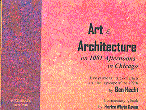
Art & Architecture on 1001 Afternoons in Chicago: Essays and tall tales of artists and the cityscape in the 1920s. Snickersnee Press. A collection of Ben Hecht's stories compiled by Florice Whyte Kovan. When she laid out this hardcover book in 2003, it was
printed in black and white. Now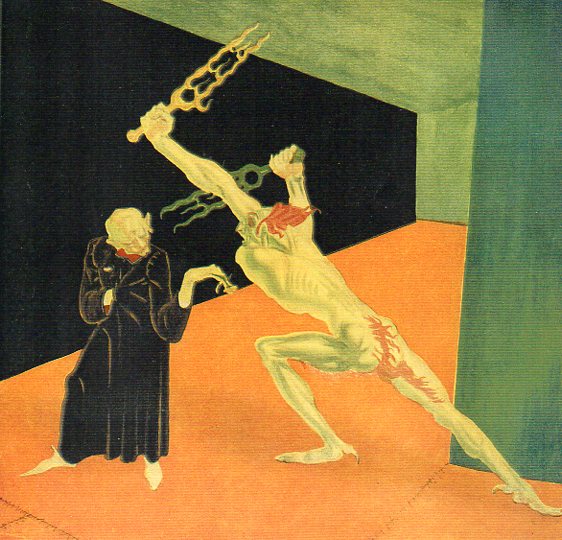 available are copies to which she has added the zest of color with hand tip-ins of Chicago buildings, art and exotic paper. Shipping now. $35.00 on eBay or buy from us directly. Request a PayPal invoice. Libraries may email purchase orders through our Contact Us link, or, fax to 202 547 0132. You may also try calling us at that number to use your MC/V/AMx/Disc We say "try" because this is our shipping site land phone, not staffed all day.
May 10, 2010. This year we observe the 100th anniversary of Ben Hecht as a senior in the Class of 1910 at Racine High School, a college prep school from which Ben graduated before beginning his career as a lionized Chicago journalist. Read our bio of Hecht to the right, where you see a cartoon of him fending off the censor (Barton, 1922) and his high school graduation photo. The successor school to Racine High is the Washington Park High School.
December 12
We invite you to fathom Ben Hecht's Holiday Thoughts as a young reporter "observing" the Christmas season in a Chicago department store and commuter train. "Traditions are things which take the place of initiative. And so people lean on them. . . ."
Buy our books of Hecht's stories
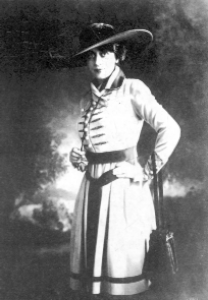
Modernists alert! We've published another Ben Hecht' story online, Petrovivacity, wherein the 1910s silent film diva, Olga Petrova, debates life with Herman Rosse, illustrator of Ben Hecht's 1001 Afternoons in Chicago book.
IN PRINT!! Art & Architecture on  1001
1001
Afternoons in Chicago: Essays & Tall Tales of Artists and the Cityscape.
Ben Hecht stories and Florice Whyte Kovan commentary and book. Snickernee Press. Ask about book-store, library or club discounts. ISBN 0-9667709-1-9.
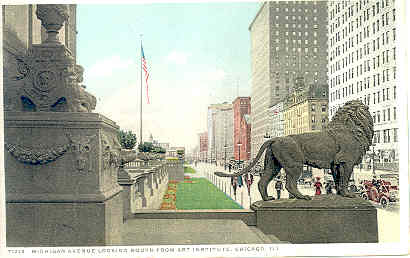
Postcard of Chicago looking west from the Art Instutute, 1910, when Hecht arrived from Wisconsin.
********
********
We found all 425 of the1001 Afternoons in Chicago stories written by Ben Hecht.for the old Chicago Daily News! Read Volume One of our new Ben Hecht annotated bibliography 101 Hard-to-Find Stories by Ben Hecht by Florice Whyte Kovan. About this project
********
Ben Hecht worked against the Klan and cast blacks in non-stereotypical roles. He consulted to the WW II Documenatry, The Negro Soldier. Ben Hecht and Civil Rights
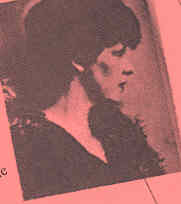
Margaret Anderson, Editor of Chicago's Little Review, launched Hecht with professional care. Image courtesy The Ben Hecht Story & News, Snickersnee Press 2000.
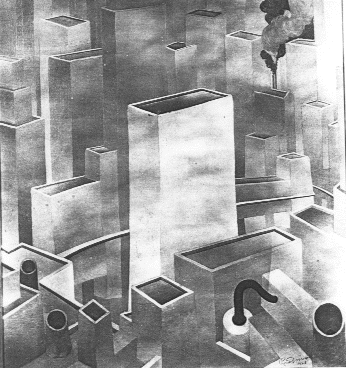
Composition by Chicago artist Ramon Shiva. Hecht supported him in his arts tabloid. Image courtesy Smithsonian Archive of American Art..
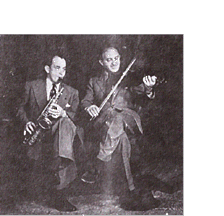
Ben Hecht on violin, right and Charles MacArthur on sax, left. They worked for rival newspapers in Chicago before writing The Front Page together
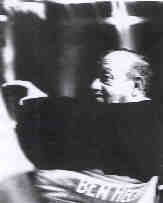
Ben Hecht on the movie set A Farewell to Arms, Hollywood. Courtesy Newberry Library, Chicago as is the one below.
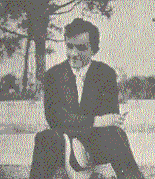
Ben Hecht on his Grant Park bench, where he people-watched and city-watched, getting ideas for his Chicago stories.
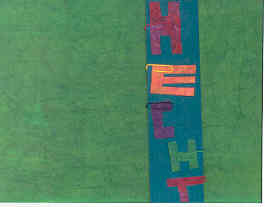
Cover of Bibliocityscape, Florice Whyte Kovan's architectural array of Ben Hecht's complete 1001 Afternoons in Chicago titles. Private collection.
His greatest effort must be remembered as his awareness of the Holocaust of millions of Jews in World War II Europe when other Americans were ignorant or incredulous. Hecht's collaboration with Kurt Weill on the 1943 Holocaust-awareness musical pageant We Will Never Die remains his stirring and frustrating effort to use musical theater to turn world events.
His greatest effort must be remembered as his awareness of the Holocaust of millions of Jews in World War II Europe when other Americans were ignorant or incredulous. Hecht's collaboration with Kurt Weill on the 1943 Holocaust-awareness musical pageant We Will Never Die remains his stirring and frustrating effort to use musical theater to turn world events.
His greatest effort must be remembered as his awareness of the Holocaust of millions of Jews in World War II Europe when other Americans were ignorant or incredulous. Hecht's collaboration with Kurt Weill on the 1943 Holocaust-awareness musical pageant We Will Never Die remains his stirring and frustrating effort to use musical theater to turn world events.
His greatest effort must be remembered as his awareness of the Holocaust of millions of Jews in World War II Europe when other Americans were ignorant or incredulous. Hecht's collaboration with Kurt Weill on the 1943 Holocaust-awareness musical pageant We Will Never Die remains his stirring and frustrating effort to use musical theater to turn world events.
His greatest effort must be remembered as his awareness of the Holocaust of millions of Jews in World War II Europe when other Americans were ignorant or incredulous. Hecht's collaboration with Kurt Weill on the 1943 Holocaust-awareness musical pageant We Will Never Die remains his stirring and frustrating effort to use musical theater to turn world events.
THE SNICKERSNEE PRESS PUBLISHES ONLY BEN HECHT (1894 - 1964) BIOGRAPHY AND WORKS. All rights reserved.
Our web site of 30 pages is devoted 
exclusively to Ben Hecht. We publish researched anthologies of Hecht's 1001 Afternoons in Chicago stories, with emphasis on the formerly uncompiled ones, which we annotate and illustrate to inform his biography as well as studies of cultural history: film, modernism, architecture, urbanism and art. We consider Ben Hecht as an early screenwriter and literary journalist in Chicago, Ben Hecht the playwright in New York, Ben Hecht the publicist and human rights activist, and Ben Hecht as Hollywood's highest paid and least reverent screenwriter.
Visit this site and buy our books online or via credit card and discover not just the legendary Ben Hecht but also the writer who emerges from the study of his life and newly found works, beginning with his Wisconsin boyhood and his youth in Chicago.
BEN HECHT BIOGRAPHY HIGHLIGHTS
BORN IN NEW YORK CITY in 1894, Ben
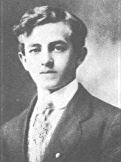 Hecht was the son of Joseph Hecht and Sara Swernovsky Hecht, garment makers from southern Russia. After several years in Chicago the family moved to the industrial inland seaport of Racine, Wisconsin. Here his father was a working partner in a womens' clothing factory, while his mother sold these wares as proprietor of the Paris Fashion store across from Monument Square. Ben's Paris Fashion tasks involved writing advertising copy, doing window displays and, he tells us, stoking the furnace in the basement under the women's fitting rooms. Shows at Racine's Bijou Theatre exposed young Ben to early films and illustrated songs between 1904-1910; but the circus touched him more closely inasmuch as the Hechts lived in a boarding house for circus people.
A Racine High School graduate (see his graduation portrait above), Hecht writes that he departed Racine in July of 1910 for a brief introduction to the college scene and fraternity life at the University of Wisconsin. He claims that he was asked to "apologize to the University" at a fraternity dinner table for his boast that he had already read the extensive freshman reading list. What, therefore, he thought, could UW possibly teach him?
ERGO, HE RECALLED -- all of this in his memoir, A Child of the Century, he fled immediately to Chicago. Particulars remain murky. Clearly, however, he focused on his literary attempts and connections early and throve in Chicago as the youngest, most creative and last to "defect" (to New York) of the Midwestern Literary Renaissance authors: Floyd Dell, Carl Sandburg, Margaret Anderson, Max Bodenheim, and Sherwood Anderson, the latter a rival of Hecht and for a time, his room mate. Hecht's real-time muckraking poem about the Titanic disaster appeared on the front page of the Chicago Journal and other papers less than two years after his high school graduation in Racine. 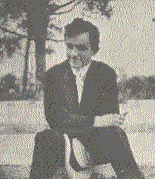
IN THE MID 1910s Hecht wrote avant-garde plays in Chicago's pioneer little theater movement with Kenneth Sawyer Goodman, namesake of the Goodman Theater. Little Review editor Margaret Anderson, favored Hecht, encouraging his serious literary aspiration as he toiled daily as a reporter, first for the Chicago Journal, then for the Chicago Daily News. Retaining his day job as a celebrity news reporter, he began his screenwriting career no later than 1915 when he teamed with John Emerson and Anita Loos as an uncredited scenarist. In 1919 Hecht served as a post-war correspondent in Berlin, an experience that invigorated him artistically and exposed him to international politics, Berlin Dadaists Georg Grosz and Johannes Baader as well as the European silent film production scene. On returning to Chicago, he wrote dailycolumns for the Chicago Daily News in his own series 1001 Afternoons in Chicago, establishing himself as a prolific and inventive short story writer and essayist. He would find material for these stories by sitting on his favorite park bench in Grant Park, contemplating the urban scene and profusion of diverse people. The stories are sometimes described (by Eastern critics) as Runyonesque in their character studies, but Ben Hecht inspired the critical term Hechtean in his taboo-breaking youth. In his flourish of literary journalism in the early 1920s, he also completed his first book, Erik Dorn, followed by Gargloyes, Fantazius Mallare, The Florentine Dagger, Kingdom of Evil and several plays, among them The Egoist. His arts and literary tabloid The Chicago Literary Times, of which Max Bodenheim was initially co-editor, lambasted Chicago's reactionary arts establishment while promoting the works of Hecht's artist friends George Grosz, Herman Rosse, Wallace Smith, Stanislav Szukalski and the cause of the avant-garde "No-jury" artists.
His "50 Books That Are Books" reading list reveals literature that influenced his later scenario writing
IN 1925 HE RETURNED TO A NEW YORK where the Algonquin Round Table was the locus of literary prestige and, for a time, he took a seat there. His work for New York Paramount Studios during this period was uncredited to evade alimony obligations. When at the first Academy Awards he won the first Oscar ever awarded to a writer, for the Hollywood silent film Underworld, he was at home in New York. His initial refusal of the Oscar (he used it as a doorstop when it was later sent to him) set the precedent for more dramatic refusals by other recalcitrant winners over the years. After his success with the stage play The Front Page and his Academy Award for Underworld, Hollywood wooed him with lavish fees. In the 1930s he was writer, producer and director of films with Charles MacArthur at Paramount Astoria Studios in the New York borough of Queens. Despite his iconoclasm and his salty criticism of Hollywood, he won a second Oscar for The Scoundrel, which starred Noel Coward in a roman a clef about the New York publisher Horace Liveright.
HECHT'S FILM CONTRIBUTIONS spanned comedies (Nothing Sacred, Monkey Business) family fare (Jumbo, Roman Holiday), novel to film aptations: Wuthering Heights, Gunga Din, A Farewell to Arms; political satire Hallelujah, I'm a Bum, Roxie Hart (yes, the first screenplay of the blockbuster Chicago), Hitchcock suspense in Spellbound, Rope, Notorious, the latter an Oscar nominee, and, under protest, remedial scripting for Gone with the Wind. Films he directed included Angels over Broadway and the noir Spectre of the Rose about a mad ballet dancer. He became a New York-Hollywood commuter, maintaining homes in Nyack and Central Park West.
His greatest effort must be remembered as his awareness of the Holocaust of millions of Jews in World War II Europe when other Americans were ignorant or incredulous. Hecht's collaboration with Kurt Weill on the 1943 Holocaust-awareness musical pageant We Will Never Die remains his stirring and frustrating effort to use musical theater to turn world events.
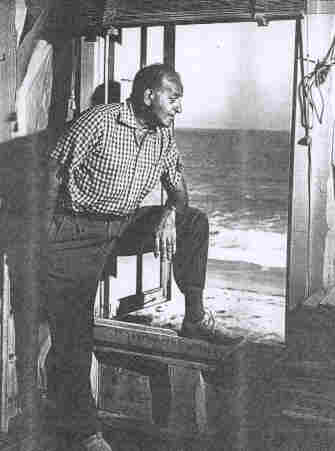
Hecht at his Oceanside, California home. Library of Congress photograph.
His California mansion was at Oceanside, reflecting a love of the sea acquired in his Racine boyhood.
431 Fifth Street NE
Washington, DC 20002
fax: 202 547 0132
snickers