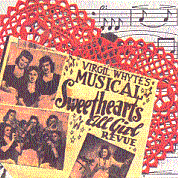
More about Virgil Whyte's All-Girl Band
Preservation
In the early 1990s, after the death of Virgil Whyte, Public & Private Research of Washington (see About Us) under Virgil's daughter Florice Whyte Kovan sponsored commemorative and educational activities during the Fifty Year Anniversary observances of World War II: A conference "Women of World War II" co-sponsored by the Naval Historical Center at Wingspread, the Johnson Foundation's conference center in 1991; several exhibits, one mounted in the Washington area with Charlotte Owen, conductor of the World War II era US Marine Corps Women's Reserve Band who were the Musical Sweethearts' hostesses at Camp LeJuene; and three 1991 exhibits in Wisconsin, at Wingspread, at the Racine Festival Site and later at the Racine County Heritage Museum. The band is proud of its year-long 1995 exhibit, "What Are Archives," at the Smithsonian Museum of American History, which houses band photographs and ephemera at the Archives Center.
The musicians reprised some of the musical standards of the 1940s at their Racine reunion concert in 1991. The Johson Foundation contributed Prairie School auditorium and the commitment of its music director Pat Badger to provide replacement musicians for some of the original Virgil Whyte All-Girl band veterans. Pioneer video artist Carol Goss Bley shot concert and reunion footage, including oral history interviews with Alice Whyte, Doris Kahl Nilo, sax, May Peterson Ricchio, bass, Alice Smaus, trombone, Donna Eeilbeck, trombone, Lillian Stanic, sax and Trudy Whyte, piano, trombone and home office manager. Flori Whyte Kovan shot the video interviews with Betty Hansen, bass, and with Norb and Mickey Gray, sax and trumpet of the laat Musigals tour. Noreen Grey, already a veteran of the Greenwich Village jazz scene, daughter of Musigal veterans Norb and Mickey Grey, wrote the reuion band arrangements, including a medley ending in "Going Home," a 1940s popularization of Dvorak's New World Symphony.
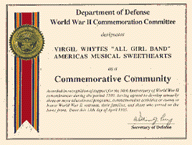
Seen above is the Department of Defense certificate designating Virgil Whyte's All Girl Band, "America's Musical Sweethearts," an official World War II Commemorative Community. In real time, written thanks were seldom seen--the band was in constant motion. But in 1945, every band member received a certificate from the Camp Hill Area of Hampton Roads, a segregated African-American camp, "for the presentation of clean, wholesome entertainment to aid the morale of the men of this camp."
Some Historical Perspective
The all women bands of the 1930s suffered the prejudice of the bad old days when women instrumentalists were considered a novelty, assumed to be third rate and marketed on their looks, attitudes that still apply today, especially to women brass players. The war, however, plucked young men off the local bandstands and theoretically vacated their musical chairs. These vacant chairs were quickly filled by woman musicians eager to make a living at their work, for what turned out, for most, to be only the duration of the war. The most competitive and adventuresome of the women musicians were in demand for shows touring theaters and military bases. The tours were grueling and the skips between one-nighters sometimes unrealistic, especially those relying on their band's own vehicles during tire rationing, gas rationing and state and county road conditions in the days before the construction of the interstate highways.
After the war, men expected to return to these chairs and did -- in a musical climate favoring smaller combos over the big bands, implying less work generally. Television soon ended the live vaudeville shows that commonly accompanied movies in local theaters, even small-town theaters. The thousands of women who played weddings, civic concerts, pit bands, dances and religious celebrations at the local level, many well-paid at union scale, were bumped off their chairs, some gladly, others desolate, in the war's peculiar musical chairs dynamics. Some of America's Musical Sweethearts finished school, whether high school or college, married, taught instrumental music locally, played at church or in the local symphony. Others continued to tour with Virgil Whyte's Musigals in trips primarily to rural areas where television was not yet available. Four band members including drummer Alice Whyte and the band's two woman arrangers formed a light jazz group, the Vadel Quintet, booked into a rare regular job at a Chicago supper club until the mid-1950s. Itinerary Available
The band continues to receive requests for information and materials. A copy of its USO itinerary as Unit 213 is available. You may send for "The Victory Tour, February 1945-June 1946. Virgil Whyte and his 'All-Girl' Band: Where they played and where they stayed."
We are also asked about the band's musical performances. We do not have a tape of commercial quality; however, the band may be heard on a scratchy cassette. Request the itinerary and receive a complimentary unedited cassette we copied from a reel to reel transription made by the National Archives from our original wax 78 rpm disks of 1945. Music and annotations include the upbeat Backbeat Boogie, B-19, (aired on Sherrie Tucker's KJAZ radio show in San Francisco) Kansas City Moods; the timely Let's Go Home, Caledonia, drummer Alice Whyte's vocal Out of Nowhere; and a swing version of Chopin's Polonaise, the latter typifying the adaptation of classics, a popular trend at the time. The recording was cut from live performances in Florida and a radio studio session in South Carolina. Be forewarned that this is very low fidelity with characteristic 78 rpm groove noise. The tape is for research only and should not be played at high decibels, on sensitive equipment or with earphones.
Oral history tapes of the band by Florice Whyte Kovan are at the following repositories: Archives Center at the Museumof American History, The Library of Congress Motion Picture Reading Room, Naval Historical Center, the Racine County Heritage Museum and the Pentagon Library.
For the perspective of Women's Studies consider Professor Sherrie Tucker's "Working the Swing Shift: Women Musicians During World War II," Labor's Heritage Volume VIII, Number 1, Summer 1996 pp. 46-66. A photo collaboration with Florice Whyte Kovan and Labor's Heritage, it is out of print.
Excerpts from the road diary of Virgil Whyte's wife Trudy Whyte were reprinted in an illustrated article, "Sharps and Flats, A Diary of the Road Life of America's Musical Sweethearts" in Image File, Volume 8, Number 3, 1995, available directly from the Curt Teich Postcard Archives.
Sherrie Tucker's book Swing Shift (Duke 2001) is the first scholarly work to provide a comprehensive overview of the dynamics of woman bands of the 1940s in their socio-cultural context. Rich in scholarship and anecdotes, it gives full chapter treatment to the Phil Spitalny, Sharon Rogers, Sweethearts of Rhythm, Darlings of Rhythem and the Ada Leonard bands and references the Virgil Whyte all-girl bands.
The Sweetheart's latest woman arranger, Noreen Grey, writes such books on music technique as Keyboard Runs for Pop and Jazz Stylists (Warner) and plays jazz in Greenwhich Village, Carol Goss Bley, pioneer video artist manages the family jazz recording business Improvising Artists with spouse Paul Bley and continues a career in painting. www.improvart.com/ Books and albums are available at Amazon.com |