Devoted to Rediscovering Ben Hecht Biography & Works
431 Fifth Street NE
Washington, DC 20002
fax: 202 547 0132
snickers
![]() |
Ben Hecht's reputation for irony and cynicism was honed by observing the dynamics of international war-mongering, defeat, victory, American jingoism and the treatment of veterans during and after the World War I years. On his return from covering impoverished post-war Germany in 1919, he became part of the young war weary generation to see the failure of reason, education and civilization to stay the course of peace in political minds. To read "Vox Populi," his 1921 story of martyrdom, lost dreams and the failure of the US Congress to enact veterans benefits after world War I, click the picture, left.
He wrote passionately about interventionism in the American isolationist era before World War II was declared and patriotic rhetoric became the norm for writers.
His Hollywood work of the 1930s and 1940s sometimes played on topical themes of national politics The President Vanishes, international intrigue Foreign Correspondent, Comrade X, Notorious Journey into Fear. Many of his columns for the New York paper PM railed against isolationism, generated sympathy for Britain before the US joined the war, and addressed the plight of European Jews when others avoided the subject.
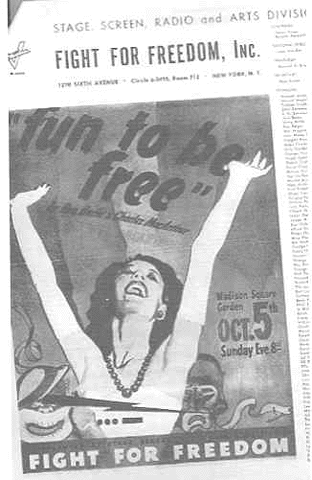
In 1941 Hecht wrote the patriotic pageant Fun to Be Free, a collaboration with Charles MacArthur, produced at Madison Square Garden. Hecht and many of his creative colleagues in New York and Hollywood were ahead of the American consensus in their passion to thwart the threat of Hitler; thus, films and live stage shows rallied readiness to fight to protect American freedom, in this case, twomonths before Pearl Harbor and war with Germany.
The day after the strike on Pearl Harbor his verse Uncle Sam Stands Up appeared in PM. Very shortly after that, it appeared in Scholastic magazine, which was distributed to schools, thereby informing high school students of their generation's impending sevice in the war.
During World WAr II, Hecht, a member of the War Writers Board, wrote radio scripts for war bond drives, pageants to honor allies; radio scripts for the Navy and the Red Cross. Two government films on which he collaborated were the widely seen OWI film The Negro Soldier with Carlton Moss, and Watchtower of Tomorrow with Alfred Hitchcock. The former sensitized military and civilians to the contributions of black troops in American wars; the latter sounded a movie fanfare for the new United Nations. Hecht's advocacy pageants and films for minorities were informed by his belief that minority concerns should be cloaked in American patriotism, especially during war.
Hecht's We Will Never Die
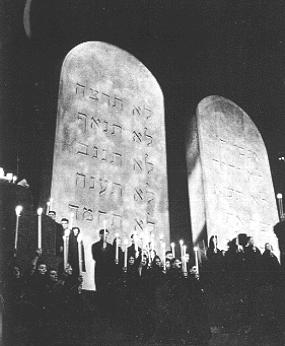
Ben Hecht's 1943 tour de force with Kurt Weill and Billy Rose We Will Never Die dramatized the Holocaust and the fight of European Jews as it was happening, offering a star-studded cast including Edward G Robinson, Paul Muni and John Garfield. Stars of similar magnitude appeared in Washington, DC, Boston, Philadelphia and Hollywood. Nonetheless, it was largely ill-received by American Jewry, who took their cues from the ensconced opinion leader, Rabbi Steven Wise, founder of the American Jewish Congress. A partner in silence at the behest of FDR, Wise frustrated Hecht by using his radio program to repudiatie him as sensational and counter-productive, thus leaving the haunting extravaganza to flounder on the open market instead of endorsing it for sponsorship through local religious organizations (left, a scene from a We Will Never Die performance).
!
431 Fifth Street NE
Washington, DC 20002
fax: 202 547 0132
snickers