A web site devoted to Ben Hecht Biography & Works
431 Fifth Street NE
Washington, DC 20002
fax: 202 547 0132
snickers
Olga Petrova Petrovivacity
An OLGA PETROVA Story, Petrovivacity by Ben Hecht
Olga Petrova, reader, thinker and silent film femme fatale of the late 1910s,
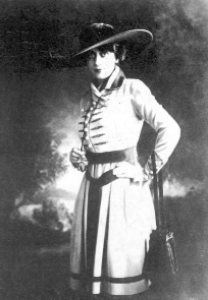 began as vaudevillian Muriel Harding in England, but in the middle of that decade, having reinvented herself as a Polish noblewoman, Madame Olga Petrova, she came to the United States.
 She was a veteran of two public service campaigns, one touring to sell World War I saving stamps, another as a Progresssive Era feminist advocating birth control in association with Margaret Sanger. In his 1922 Chicago Daily News story, "Petrovivacity," Hecht riffs on Petrova's play The Stork and her dubious press-agent genealogy in his dialogue account of her spirited intellectual repartee with Herman Rosse, Hecht's illustrator and a set designer.
Madame Petrova's business office claimed that in 1917 more money was spent publicizing her in trade magazines than on any star previously. In that year her film work included at least eleven motion pictures: Daughter of Destiny, More than Poetry, Exile, The Silence Sellers, To the Death, Law of the Land, The Undying Flame, the Soul of a Magdalene, The Waiting Soul, The Secret of Eve and Bridges Burned, IMDB. No wonder she did the math, finding by her own calculations, that the speaking stage offered her more free time than film work, and the pay was better: $357 per hour, compared to film work, just $208. When Hecht wrote "Petrovivacity" as one of his 1001 Afternoons in Chicago columns, she had retired from motion pictures and was writing and producing her own plays.
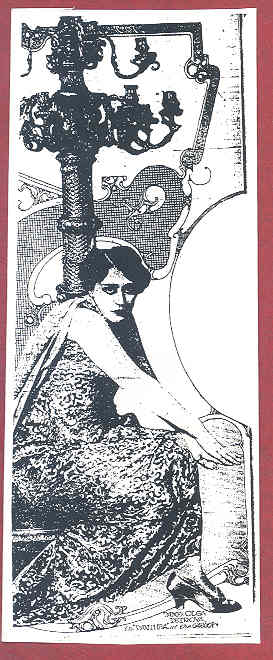
Ben and his spouse Marie Hecht, she a scenarist and Chicago enertainment columnist, knew Petrova since her stage-to-film transition. She played in Pathe at Chicago's Garrick Theatre in June of 1914 (left), well before she became Metro's flrst star and owner of Petrova Pictures. Marie, who was also a gourmet cook, recalled stopping to make a frenzied call home while en route there with Petrova for dinner. The diva had just announced that she never ate fowl, which awaited them in the oven. That Petrova did some of her own writing and was the Hechts' dinner guest raises the question as to whether she consulted with them. This is more than plausible inasmuch as Ben was writing for Chicago little theater and motion pictures by 1915, and, soon after, contracted as a sideline for work writing scenarios for screenwriter Antia Loos. The people he chose to honor with a 1001 Afternoons column were usually people in whom he had a business interest, e.g., his stories about Wallace Reid and Charlie Chaplin.Hecht's account of Petrova's contentious philosophical debate with Herman Rosse illuminates not only their love of ideas but Hecht's long-established ease with modernist arguments as a reader of Nietzsche, a protégée of editor Margaret Anderson and a participant-observer in the DaDa movement while he covered post-war Germany in 1919. In "Petrovivacity" Hecht indulges his love of eloquence and wit. Reproducing rapid-fire dialogue, whether low-brow or high-brow, became a hallmark of his writing as exemplified in plays like The Front Page, the more literary talkies like The Scoundrel and his screwball comedies of the Golden Age.
Above, Olga Petrova, Library of Congress photograph as seen in Florice Whyte Kovan's book,Rediscovering Ben Hecht: Selling the Celluloid Serpent. Snickersnee Press. 2000. Left, drawing of Olga Petrova in Pathe from the Chicago Sunday Tribune, 1914.
optimistically. "Man today owes man of yesterday a vast debt."
"Oho!" exclaimed Mme. Petrova, "then
you think that man has improved? What
nonsense! Man is becoming more and
more a creature dependent upon buttons.
In two hundred years he will be nothing
but a button presser. If he wants to blow
up anybody he will press a button. If
he wants to go somewhere he will press
a button. If he wants excitement,
beauty, scenery, money, comfort, laws or
conquest he will press buttons."
"You do not like machines?" inquired
Mynheer Rosse, bristling. "You are not
a modernist! See, with all your egoism
you are a sentimental yearner after quiet,
peace and mid-Victorian beauty."
"You misunderstand me," sighed Mme.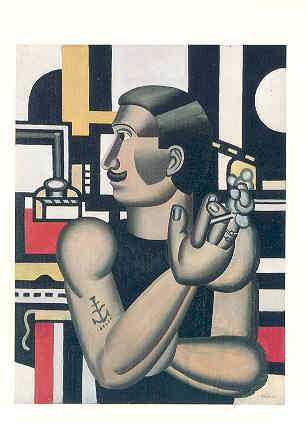
Petrova. "I adore machines. They are infinitely superior to men. Machines
contain in their steel jaws and iron souls
the power, freedom and egoism that
were once the property of men. Man has emptied himself into machines. I could love a hydraulic elevator. I grow positively enthralled before a donkey engine and a steel shovel. But men -- bah"
"But it is men who invent machines,"
continued Mynheer Rosse.
"For every machine invented man loses
something," smiled Mme. Petrova. "Man
is now comparatively impotent. His brain is filled with sawdust instead of ecstasy. His soul is a memory that lives only in literature. He is dead. The race awaits some great embalmer."
"But," said Mynheer Rosse, "you are
neither dead nor even partially devitalized."
"But," said Mme. Petrova, "I am an
exception. I am Lucrezia Borgia, Catherine of Russia and many other anomalies. I am one of those few who furnish the race with an almost plausible excuse for its existence. My instincts are all antiracial. I am in revolt against the things which produced me. Life is my inferior. "
"I don't know," Mynheer Rosse shook his head, "egoism is a happy misfortune. But I fmd it silly. I prefer your accent to your ideas, the shape of your nose to your paradoxes. So you see you are admired for accidental virtues."
"Which is your failing, not mine," said Mme. Petrova. "But I fear we are wasting time. I am writing a new play."
"And I am painting a new picture," sighed Mynheer Rosse.
"I am really glad to have met you," said
Mme. Petrova.
"And I you," said Mynheer Rosse.
Thus at 4:35 Wednesday afternoon the
argument ended. The phosphorescent Olga returned to her chamber to work upon the play that is to captivate the admiration and dollars of the public for fifty-two weeks in New York ---if her hopes come true. And the belligerent Mynheer Rosse returned to the painting of his canvas, which will be admired by twelve people and bring him $250 -- if he is lucky.
Illustration, above: Le Mecanicien by futurist artist Fernand Leger, 1920.
*******
Herman Rosse, a native of Holland, thus the courtesy title "Mynheer," brought degrees in art and architecture to his work as head of the design department at the Art Institute of Chicago. His shadowgraphs and projected scenery were subjects of early issues of Theatre Arts. His books of the early '20s include Designs and Impressions (1920), illustraitons for 1001 Afternoons in Chicago, with Hecht (1922) and Masks and Demons with Kenneth MacGowan (1923). Rosse is credited with art direction for several early sound fIlms, including Dracula and Frankenstein. His design work for King of Jazz in 1930 (below) won him the Academy Award.
A month before Hecht wrote this piece, the two of them took their play, The Yellow Mask, to show J. J. Schubert in New York. Hecht wrote of the meeting in his column: "Mynheer Rosse astounded the wary impresario by removing one of his Holland shoes and extracting the manuscript therefrom."
Hecht and Rosse each took up family residences in Nyack, New York, where they remained neighbors and friends for life. See more about Ben Hecht and Herman Rosse .
If you liked this story see a book of Hecht's essays and stories about art and modernism in Chicago.
Have you read Hecht's other stories about silent film people of the early 1920s?
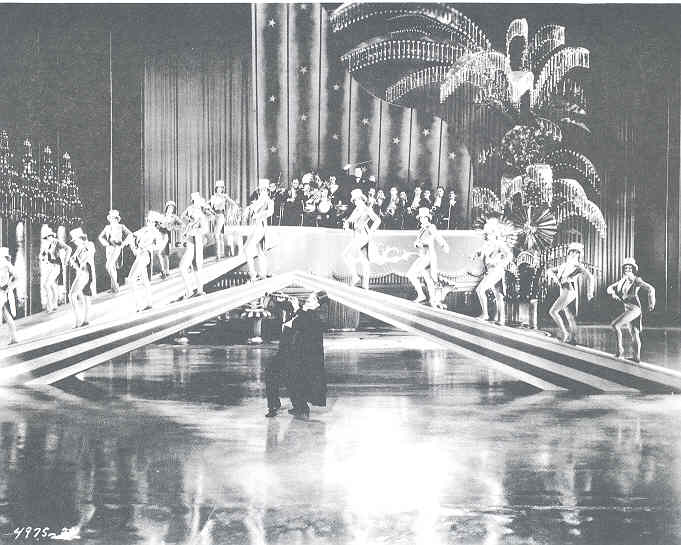
Above: One of Rosse's stage designs for his Oscar-winning King of Jazz, a Paul Whiteman vehicle.
Photograph oourtesy Film Stills Archive.
Museum of Modem Art, N- York
431 Fifth Street NE
Washington, DC 20002
fax: 202 547 0132
snickers