A web site devoted to Ben Hecht Biography & Works
431 Fifth Street NE
Washington, DC 20002
fax: 202 547 0132
snickers

Ben Hecht 101 Hard to Find Stories from the Chicago Daily News and the Chicago Literary Times. Florice Whyte Kovan's Annotated Bibliography of the 1001 Afternoons in Chicago Stories
Found languishing on unindexed microfilm in a marathon research effort by Flori Kovan, these 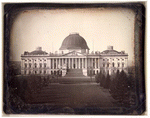 101 stories are from her complete checklist of the 425 stories Ben Hecht wrote under the 1001 Afternoons in Chicago banner for newspapers. Forty of the 435 have been reprinted by the Snickersnee Press with Kovan's research notes and book layouts. Unless otherwise noted, these stories were published by the Chicago Daily News. We add links to the full text of those accessible on this site or to hard copy publications in print and available for purchase.
Quote or link to this annotated bibliography with the citation Ben Hecht: 101 Hard-to-Find Stories. Florice Whyte Kovan, snickersneepress.com and date.
Picture above, Library of Congress, where the stories were found and researched.
Alms and the Man.
Ben Hecht interviews a Chicago street beggar about the giving habits of residents of various neighborhoods and social classes. June 28, 1921. Chicago Daily News.
Amy Leslie and the Faithful Cab.
Amy Leslie, the theater critic, recalls how the horse who drew her regular cab home from the theater one night took her slowly home as usual, although, as she later learned on alighting, the driver had died in his seat. October 10, 1922.
The Ancient, Reluctant Conscript.
An extra in epic war films of the silent film era tells his war stories and packs for work in Italy. November 12, 1921. In Print!
Another Arabian Night.
The male secretary of matinee idol Wallace Reid replies to his boss’s mash mail with equal ardor, losing his job and creating troubles for Mr. Reid. January 3,1922.In Print!
The Auctioneer’s Wife.
An auctioneer’s wife has a weak spot for buying his items but then divorces him over his exaggerations. November 21, 1921.
The Back of Bohemia
The Dill Pickle Club’s forum for Chicago’s more radical artists and speakers are described by Jack Jones who runs the club in Tooker Alley. March 18, 1922
Balladelirium
Popular songs of the day are considered while the newspaper man visits Wabash Avenue, Chicago’s Tin Pan Alley. July 12, 1921
The Bamboo Flute
An Asian musician is saddened by the American custom of the audience joining in the music instead of listening and meditating on the music he plays on his bamboo flute. June 10, 1922.
The Bargain.
The landlady of a boarding house rejects the low appraisal on a painting left her in lieu of rent, maintaining her illusion that it is valuable. September 1, 1921.
The Bees Knees.
A primer on flapper slang by two brash young women overheard in a hotel lobby. Dialect. May 24, 1922
The Black Couch
An auction house is visited repeatedly by a mysterious man who each time increases his offer on a black couch held for a previous buyer. November 1, 1923. Chicago Literary Times.
Buried Treasure.
A bank officer recalls the contents of safe deposit boxes and behavior of their owners. October 19, 1921.
Buried Umbrellas.
An encounter, possibly a fantasy, with a woman at the newspaper man’s (Hecht’s) side as they walked in a rainfall. December 8, 1921
The Candid Seeress.
A self-styled fortune teller reveals her formula for pleasing clients. October 5, 1922.
The Cat Man.
A man who can not speak collects cats who obey him even though he is mute. His interview responses to Hecht are penciled out and each is signed “E.” February 24, 1922.
Concerning Magnetized Balloons.
A Chicago man takes his discovery to the Chicago Daily News: He shows the newspaperman that balloons will stick to each other and other things when “magnetized” by rubbing them! January 30, 1922.
Coronation of Clarence O’Toole.
A sailor is part of a melee in Bugsville Square, across the street from the Newberry Library. August 4, 1922; July 6, 1921.
Curtains.
When a courtly theater usher dies, so, it seems, does an era of grace in the American theater. July 30, 1921. In Print!
Da Da.
German Dadaist Johannes Baader comes to Chicago and reacts to the Ku Klux Klan movement in this strange hotel interview in which he speaks standing on his head. August 27, 1921. In Print!
Domashovitz.
The life and death of the self-educated Domoshovitz, editor of a West Side socialist paper, is recounted by the new editor. November 9, 1921.
The Dope.
An addict brought into into court pleads for a fix and can not recall why he beat his wife. November 17, 1921.
The Enchanted Exiles.
The Wrigley Building inspires awe in expressionist artist George Grosz, whose agent, Herman Sachs meets Hecht at the new landmark to tell the story. September 18, 1922. In Print!.
The Faithful Lorelei.
An artist who in youth may have had talent abandons painting out of need to make a living. His midlife return to painting finds that his talent is now lost, a classic carpe diem story for Hecht. September 29, 1922. In Print!
Fifty Books That Are Books.
Hecht’s epigrammatic list of the classics he would recommend for fine binding in 1922. August 26, 1922. Read full text here.
First Hour of the First Moon.
A Chinese man dies at the age of 100 in the back of his store on the first day of the Chinese New Year. February 4, 1922.
The Flying Dutchman.
A theater advance man lives a whirlwind life from hotel to hotel. July 16, 1921.
From the Angle of Thirteen.
A father teaches his thirteen year old son a lesson in bias as they view the ethnic exhibits at the Field Museum. July 29, 1921
The Future Fish.
A black podiatrist who works on Chicago’s gold coast gives advice about the evolution of the foot. October 11, 1921.
Headlines.
Hecht disparages Sherwood Anderson’s move to the suburbs and his fear of the city as well as raising other bones of contention. October 15, 1921. In Print!
Hilda’s Irritating Pa.
A woman remembers with annoyance her father’s voicing of Socialist party beliefs when she would visit him in Iowa. May 15, 1922.
His Last Samoleon.
With money enough for just one more day of a job search, a man eyes the beggars he will soon be joining. July 1, 1921.
Holiday Thoughts.
A trip to the toy department of a large store evokes fantasies of toys animating and memories of childhood. December 5, 1921. In Print! Read full text here
Homo Sapiens.
A man who is robbed in front of his house as he arrives late from work finds a complaining wife who joins with the police in doubting his account of the robbery. February 11, 1922
How Chauncey Discovered the Middle of Next Week.
The world-traveled, bored son of one of Chicago's ’s richest families is enrolled by his mother in boxing lessons to startle him into greater consciousness. August 3, 1922; July 2, 1921.
I Got the Blues.
The soulful blues stanzas from a cabaret singer serve as a background for the complaints of a European guest that Americans are lacking in soul. August 25, 1922. Read full text here!
Impressions at an Amusement Park.
Specific acts, chats with carnival people and the gambling obsession are among Hecht's observations as he visits a carnival. August 1, 1921.In Print
In the Library.
Books are like ghosts who say, “We were, we are no more,” but the buildings of a big city say, “We are.” January 6, 1922.
The Indestructible Masterpiece.
An artist, run out of credit at his favorite saloon, gives a painting to the proprietor and insures it for $2,000. In this original version the artist Frank Peyrude was a subject. He objected and his name was omitted in the Covici book. July 25, 1921. In Print!
An Iowa Humoresque.
A singer who before leaving her small hometown turned down a marriage proposal from an ambitious young man who felt he could be president if she married him returns home to find him now a garbage collector. October 14, 1921; July 28, 1922.*
Janitor Joe and the Higher Criticism.
A janitor who appreciates the art seen in the more conventional Tree Studios lambastes the modernists shown at a Michigan Avenue gallery. November 8, 1921. In Print!
A Jazz Martyr.
Band leader Solly Wagner changed to the new jazz repertoire and is now assailed by such notables as Alfred MacArthur, Lucy Page Gaston, JP McEvoy and Burton Rascoe for abetting moral decline. February 7, 1922.
Jeritza.
Hecht mocks the personality of Maria Jeritza, an Austrian opera diva who immigrated to the United States and had recently begun her American career at the Met. September 5, 1922.
The Knockout.
Norman Selby, alias Kid McCoy, has abandoned his professional boxing career to play fight scenes in movies. March 13, 1922. In Print!
Lavender Slippers.
Durot, a grief-stricken poet binges on the check he received from Harriet Monroe’s Poetry Magazine and steals a pair of lavender slippers to put on the grave of his dead lover. The story is about Max Bodenheim. February 18, 1922
Letter to Ta-Samo, A.
Jerome Blum, an artist on Tahiti returns to Chicago, which he describes as less civilized than the South Sea Islands in this letter Hecht writes in his name to Chief Ta Samo. August 11, 1921.
Life Talks to Ramoshovitz.
Repetition and meter characterize this story about the litany of tragedies in the life of Romoshovitz. September 11, 1922.
The Love Interest.
A manicurist wishes her barber boyfriend were more ferocious, like Harrison Ford in the film The Primitive Lover. July 13, 1922. In Print.
A Love Story.
A man rationalizes concealing his Jewish heritage from a woman he loves.
March 1, 1922
Mack Sennett’s Soul.
Mack Sennett, the movie producer, complains to Hecht that there is no place for him to hide from an inquisitive public and press. September 21, 1921. In Print.
The Man with Five Bull Fiddles.
A prosperous businessman keeps five bass viols at work at home and at his clubs so he can relax by playing whichever venue he frequents in a typical day. July 26, 1921.
The Mayor’s Understudy.
A representative of the mayor’s office narrowly escapes a major blunder in nearly congratulating the wrong ethnic group he is addressing in one of his many similar speeches. October 28, 1921.
Milwaukee Avenue Complex.
A photographer laments wanting to photograph his fiancée as an artist would, but she wants only the conventional wedding photographs. May 15, 1924 Chicago Literary Times.
The Miracle.
A religious revival tent show raises questions about the role of religion. August 29, 1921.
The Miracle in the Morgue.
A prominent surgeon recalls his days working for the county coroner in whose laboratory a corpse appeared to levitate. May 1, 1924.
Mirror of Illusion.
A young woman jumps to her death off a bridge in Chicago’s Jackson Park. August 26, 1921.
Mishkin’s Idealist.
A dying elevator operator who believes all great people of the world are really Jewish is given a bon voyage party before his trip to Palestine. November 15, 1923, Chicago Literary Times.
Mishkin’s Riddles.
Feodor Michkin suffers from an unsettling experience with a neighborhood rabbi's son who attempts to explain the theory of relativity to him. June 8, 1922. In Print
Moon Quan.
The Chinese cultural consultant to DW Griffith’s movie Broken Blossoms appears completely Americanized. Quan is returning to China to marry a bride chosen by his family, but Hecht and others expect his return. December 15, 1921. In Print.
A Movie Double.
The life of a stunt woman for silent film stars is described. She is never the one who is kissed. December 16, 1921. In Print
Mr. Pazumba. A magician from Ceylon visits Hecht’s office and ties him up in rope tricks. January 31, 1922.
Mr. Ziegfeld’s Merciless Cuties.
Police guarding the stage door to protect Ziegfeld girls from admirers find they are protecting the admirers from the aggressive pre-emptive strikes of the women. January 14, 1922
Mrs. Paden’s Socialism.
A genteel and wealthy Chicago aristocrat is also a well-known socialist. June 28, 1922
My Last Park Bench.
Ben Hecht bids a bittersweet goodbye to Chicago from the bench in Grant Park where he often contemplated the skyline and the people in the park. June 1, 1924, Chicago Literary Times. In Print!
For stories with titles beginning N-Z Go to page 2
Copyright Florice Whyte Kovan. All Rights Reserved. Please quote, link or review with this citation: Ben Hecht: 101 Hard-to-Find Stories. Florice Whyte Kovan, Snickersneepress.com/ plus date.
431 Fifth Street NE
Washington, DC 20002
fax: 202 547 0132
snickers